
When moving from Vancouver to Nanaimo, coordinating your mortgage financing across two properties requires careful timing between subject removal and completion. This piece is for someone who owns in Vancouver, or who is selling in Vancouver, and is buying on Vancouver Island. The mortgage file has two properties in it until one of them is sold. There is no Nanaimo page on the site yet. The Vancouver mortgage page is the closest page, and the renewal page covers a Vancouver mortgage that is coming due in the same stretch of time.
A move does not replace the income test. The lender still uses your income, your debts, and the down payment you can document. What changes is that the old home and the new home can both be in the file on the same day. Write the dates down before you remove subjects. Subject removal is the day the contract becomes firm. Completion is the day the money has to be at the notary or the lawyer. Those are different days, and the lender works off both of them.
Selling Your Property When Moving from Vancouver to Nanaimo
If you are selling, the lender needs the sale contract, not a plan to list the home later. A listed home is not a sold home. The payment on the Vancouver mortgage stays in the file until the sale is firm and the completion date is in writing. A firm sale means the subjects are removed. Until that happens, the lender treats the Vancouver payment as a bill you still have.
Each contract has its own subject date and its own completion date. Send both contracts together. If the Vancouver sale completes first, the old mortgage is paid out before you need the Nanaimo money, and the file is simpler. If the Nanaimo purchase completes first, there is a gap. Some lenders will look at a short loan, called a bridge, for the days between the two completions. They usually want the Vancouver sale to be firm before they will count that bridge. If the sale is not firm, do not build the offer around a bridge.
The down payment has to be traced. If it is coming from the Vancouver sale, the lender wants to see that the sale price, the mortgage payout, and the costs still leave the amount you are using. If a family member is giving you part of the down payment, the lender will ask for a gift letter and a record of the transfer. A gift that is really a loan will be counted as a debt.
Keeping the Vancouver home
If you are keeping the Vancouver home, the lender counts both housing payments. That means the Vancouver mortgage, the property tax, and the strata fee if there is one, plus the new Nanaimo payment. This is the part that changes how much you can borrow. Rent can help, but only when there is a lease the lender will use. Some lenders count part of the rent against the payment. The share they use is their rule, not a number you can assume. The rental purchase page and the note on rental income explain how rent is treated on a file. Send the lease if you have one. A plan to rent the home later is not a lease.
Keeping the home also means the Vancouver mortgage stays in your name. It does not move to Nanaimo. The Island purchase is a new application. If that Vancouver mortgage renews in the same month, send the renewal date with the purchase contract. A renewal and a purchase are two files. The renewal page is the one to read if the current lender has already sent an offer.
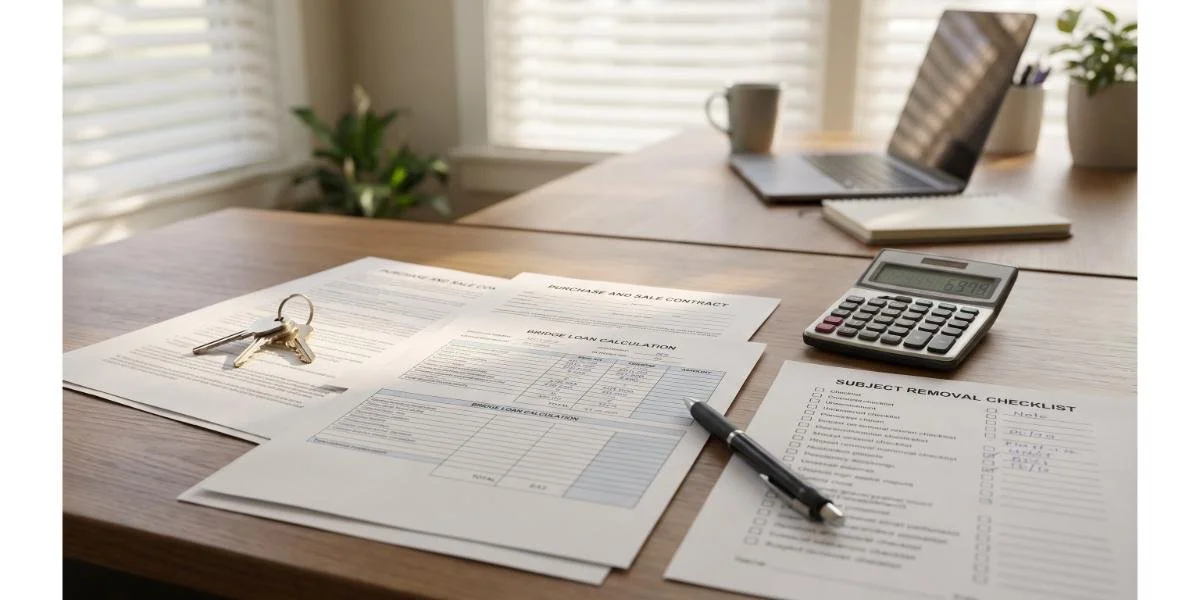
What to send before you remove subjects
Send the papers before the subject date, not the day before completion. The subject-to-financing note is the short version of why that gap matters. The lender has to read the contract, order an appraisal if they want one, and send instructions to the notary. A completion that is only a few days after subject removal does not leave time for that.
The Nanaimo purchase contract, including the deposit schedule and both dates.
The Vancouver sale contract, if you are selling. If you are not selling, the current mortgage statement, the tax notice, and the strata fee if there is one.
Income documents. For a job, that is a letter and recent pay stubs. For self-employment, that is usually two years of returns and the notices of assessment.
Down payment records. Bank statements that show the money, or the gift letter and the transfer.
A list of other debts, with the balance and the payment on each one.
If the Nanaimo home is a strata, the lender may ask for the strata documents. Send whatever the contract already gives you. Do not wait for the lender to discover the strata on the appraisal.
The rate hold expires
A rate hold covers the completion date written on the commitment. It is not the same length at every lender, so the date on the paper is the one that matters. If the Nanaimo completion moves, or the Vancouver sale moves, send the new date before the hold ends. If the hold ends first, that rate is gone and the application is done again. A second application can mean another look at your credit.
One application from this office goes to more than 50 lenders. You do not pay the broker fee. The lender does. Chad's BCFSA licence number is 142612. He has worked on Vancouver mortgages for more than 15 years. You can run a payment on the mortgage calculator, read the first-home page if this Nanaimo purchase is your first buy, and use the questions page for the short answers. If you are moving from Vancouver to Nanaimo, visit the about page or the contact page to send your contracts and get your financing in order. The application form is here.
Questions people ask about this move
Can I buy in Nanaimo before the Vancouver home sells?
You can if the lender can qualify you with both payments, or if the Vancouver sale is already firm and the dates work. If you still have subjects on the sale, and you cannot carry both payments, the Nanaimo offer has to wait or it has to be written so you can walk away.
Does my Vancouver mortgage transfer to the Island house?
No. The Vancouver charge stays on the Vancouver title until that mortgage is paid out. The Nanaimo purchase needs its own approval, its own instructions, and its own advance on completion day.
What if both completions land in the same week?
Tell the lender and the notary as soon as the dates are set. Same-week completions fail when the sale proceeds are not in the account on the morning the purchase money is due. A firm sale with a completion a few days earlier is easier than two completions on one day.
Who pays Chad?
The lender pays the broker fee. You pay your notary or lawyer, and you pay any appraisal the lender asks for. You do not pay a broker fee on top of that for this file.
